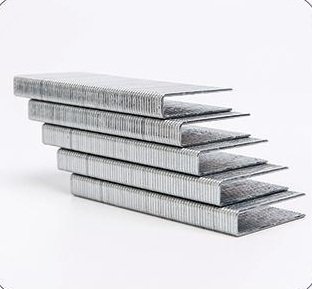
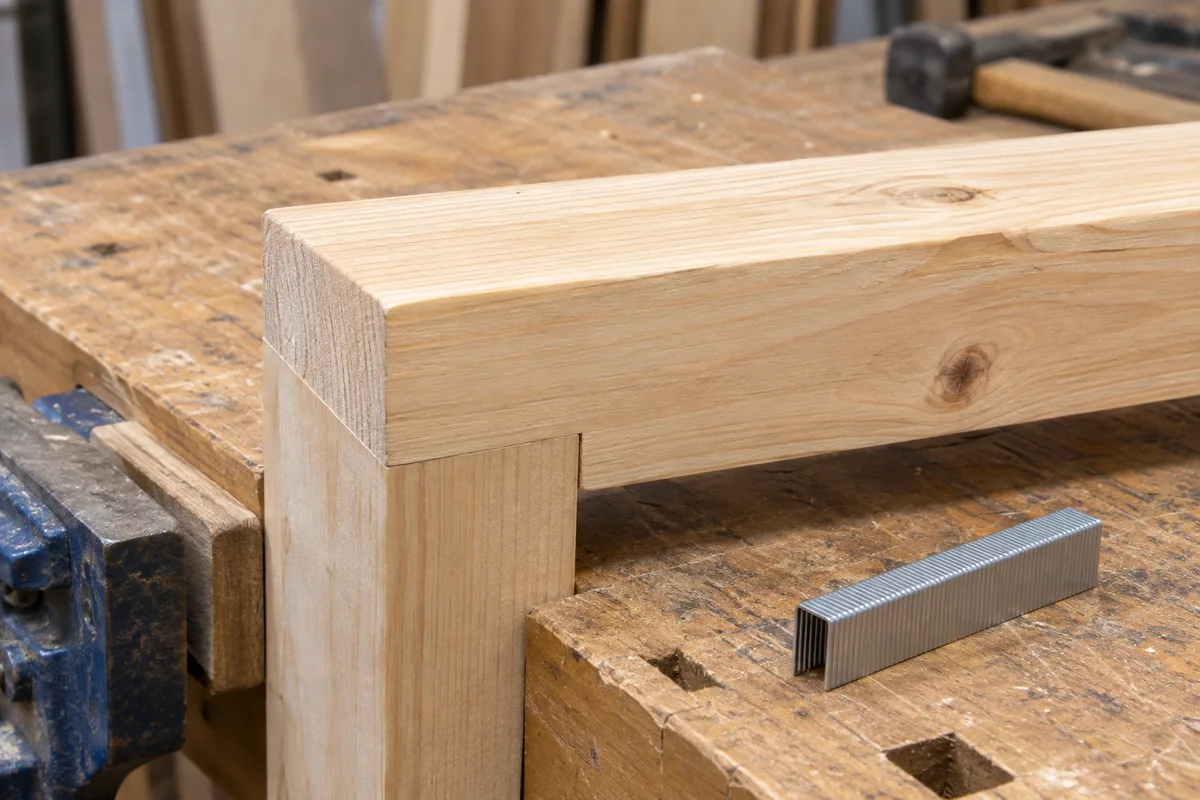
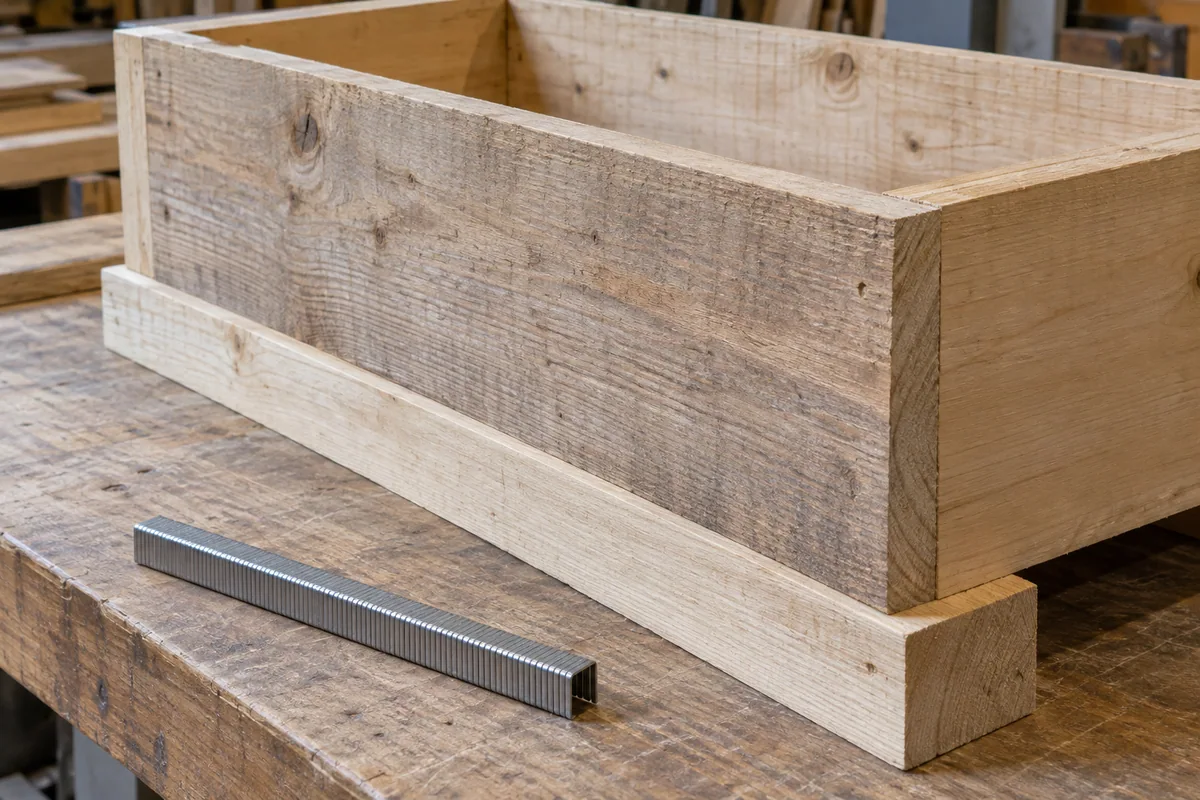
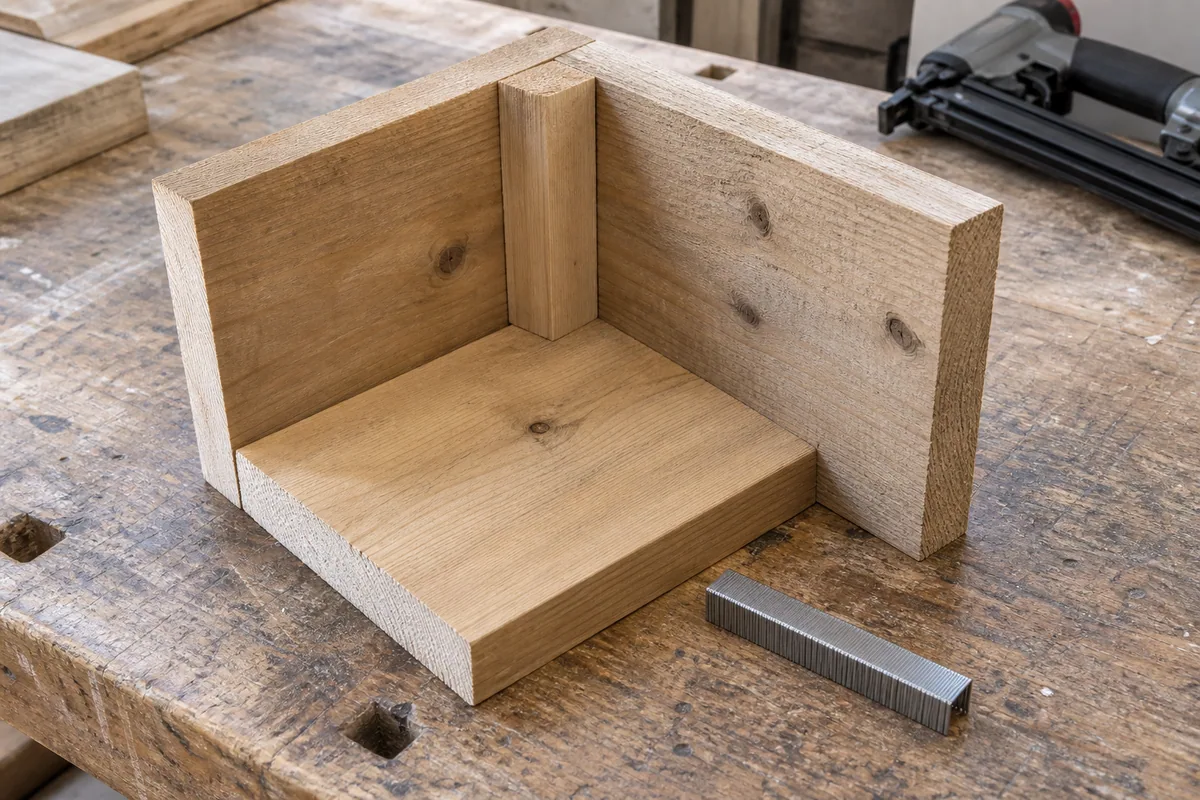
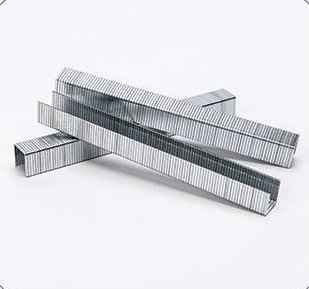
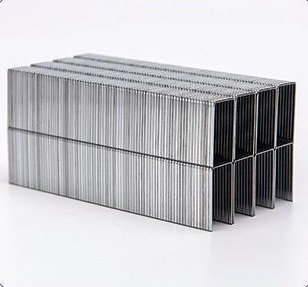
Source-confirmed nominal inch labels are shown where documented. Unverified dimensions remain in the source unit; listed references do not imply every size combination is available.
1450 Series 17 Gauge Industrial Staples · catalog reference sizes
Reference
Length (mm)
1420
20 mm / 3/4 in (nominal)
1425
25 mm / 1 in (nominal)
1430
30 mm / 1 3/16 in (nominal)
1435
35 mm / 1 3/8 in (nominal)
1440
40 mm / 1 9/16 in (nominal)
1445
45 mm / 1 3/4 in (nominal)
1450
50 mm / 2 in (nominal)
On smaller screens, swipe the table to see every column. Confirm the final drawing, tolerances and packaging before ordering.
Wire thickness needs drawing confirmation before an order is placed.
FOUR DIMENSIONS BEFORE A SERIES NUMBER
Read the crown, wire and leg together.
Crown width
Leg length
Wire section
Width × thickness
Measurement guide · schematic, not to scale. Refer to the listed dimensions and an approved order drawing.
1450 Series 17 Gauge Industrial Staples: check the entire cross-section
A familiar series number helps identify a starting point. The crown width, wire width, wire thickness and leg length determine whether a candidate staple matches the tool and joint.
1. Record the crown width and confirm the supplier’s measurement convention on the order drawing.
2. Record both dimensions of the wire cross-section; gauge alone is insufficient.
3. Choose a listed leg length for the material stack and required penetration.
4. Compare the dimensions with the exact stapler model and approve a sample.
This reference lists 17GA, a 10.5 mm crown and 20–50 mm legs. It serves a different selection task from the 22GA 1416 covering staple.
02
Resolve the wire drawing
Confirm the wire cross-section before ordering: the reference table and drawing disagree on thickness. Supply your current staple sample or a controlled drawing.
03
Approve the joint and tool together
Check feeding and driving, then inspect both legs, splitting and opposite-face projection. Use your component performance requirement for retention and repeated loading.
DEFINE THE ORDER, NOT JUST THE FASTENER
Packing, samples and order documentation.
Quantity & packing unit
State your quantity in pieces, strips, reels, boxes or cartons. Confirm the conversion between inner packs and shipping cartons.
Samples & minimum order
Send the selected specification and trial quantity. Sample availability, minimum order and lead time will be checked for the requested configuration.
Labels & documentation
Discuss custom packing, private labels and required drawings or documents before order approval. Keep an agreed sample, label and specification reference for repeat orders.
No. Timber condition, penetration, spacing, edge distance and assembly design also matter. Verify the proposed joint rather than relying on gauge alone.
Application limits to check
Do not substitute 1416 or another manufacturer's 14-series staple by name.
Do not claim structural construction approval from the heavy-wire classification.