
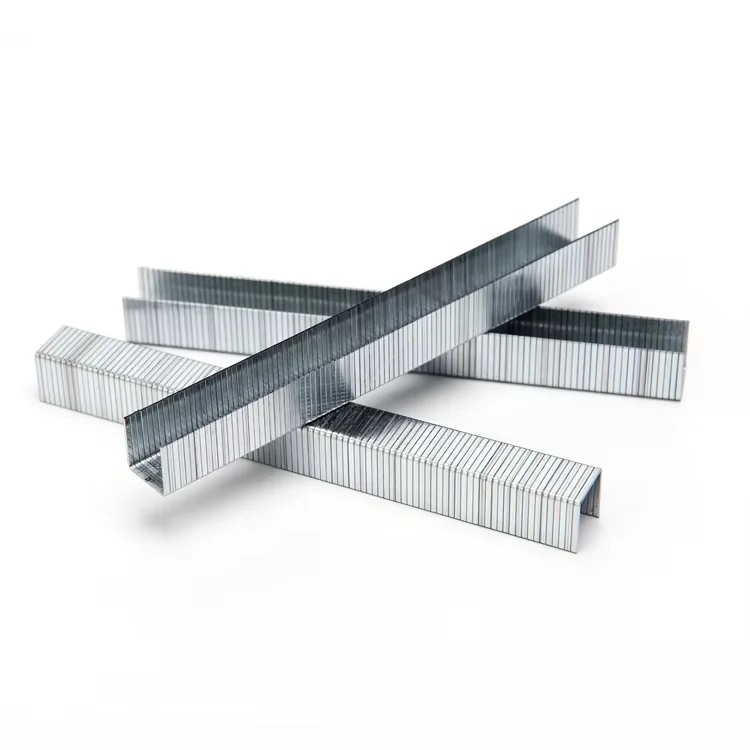
FOR THE BUYER
Send the tool nameplate and current staple label, and have the supplier confirm crown, complete wire cross-section and strip format before choosing a 71 or 80 reference.
7116 and 8016 catalog references: shared leg lengths conceal different geometry
Reference field
7116 Series / 71 family
8016 Series / 80 family
Purchase check
Crown, as recorded in the catalog
9.00 mm
12.90 mm
Confirm the drawing’s measurement convention and the exact tool’s accepted crown.
Gauge designation
22 gauge
21 gauge
Retain the gauge label together with the formed wire dimensions.
Formed wire thickness
0.60 mm
0.70 mm
Compare the approved cross-section with the tool requirement.
Formed wire width
0.75 mm
Drawing confirmation required
Do not fill the unresolved 8016 width from a similar series or nominal inch conversion.
Listed leg lengths
6, 8, 10, 12, 14, 16 mm
6, 8, 10, 12, 14, 16 mm
Choose the length for the material stack and the permitted tool range.
Listed product codes
7106, 7108, 7110, 7112, 7114, 7116
8006, 8008, 8010, 8012, 8014, 8016
Keep the complete code on the RFQ and approved sample.
Catalog pieces per row
100
125
Confirm quoted strip format and box/carton contents separately.
Catalog reference values are not a tool-interchangeability declaration or confirmed supply offer. The 8016 formed-wire width is intentionally withheld pending resolution of the source discrepancy; no replacement value has been inferred.
The same leg length does not make two staples interchangeable
A buyer replacing an upholstery or furniture staple may begin with a 10 mm or 16 mm leg length. That is only one dimension. A staple must also match the tool’s accepted crown, wire section and feed format. Ordering by leg length alone can produce a product that looks familiar but is outside the required specification.
SENCO’s official staple selection separates gauge, collation and application. That is a useful purchasing approach across brands: first identify the complete fastener family, then choose the appropriate length. The manufacturer’s own categories do not establish that an Elite reference series substitutes for a SENCO product.
Compare the two catalog reference families
The supplied reference catalog lists 7116 Series with a 9.00 mm crown, 0.75 mm wire width, 0.60 mm wire thickness and 22-gauge designation. Its listed lengths are 6, 8, 10, 12, 14 and 16 mm, using references 7106 through 7116. The row format is listed as 100 pieces.
For 8016 Series, the reference values include a 12.90 mm crown, 0.70 mm wire thickness and 21-gauge designation. The wire width needs a confirmed drawing because source labels conflict. Listed lengths run from 6 through 16 mm in 2 mm increments. Shared leg lengths do not establish the same crown, cross-section or stapler fit.
Check how dimensions are being named
Ask whether crown width is measured on the outside, inside or another drawing reference. Do not convert a familiar fraction into a guaranteed match without checking the drawing. Catalog inch labels may be nominal or rounded, while a receiving inspection requires an agreed dimension and tolerance.
Keep the original wire diameter separate from the formed wire width and thickness. The product reference records both, but they describe different things. A quote that gives only gauge may still leave the wire cross-section unresolved. Request the formed staple dimensions used by your equipment manual and supplier drawing.
Select around the assembly as well as the tool
Describe the fabric, board or timber being joined, the total material stack and the required appearance. Ask for the candidate staple to be assessed on that assembly. Do not replace a narrow or fine staple with a wider or heavier family solely because the latter sounds stronger.
Material and finish also belong in the specification. The catalog describes zinc-coated wire and mentions a stainless option, but exact grades and available combinations need confirmation. If a staple may remain visible or contact a sensitive surface, include the relevant appearance or material requirement in the sample review rather than leaving it to the series name.
Prepare an identifiable replacement request
Include the full tool model and a photograph of its identification plate. Attach the current carton label, a staple drawing or a measured sample, and state whether you need an exact replacement or a proposed alternative. Samples should be checked using the intended equipment in accordance with its manual.
- 7116 / 8016 family or existing supplier reference and required leg length.
- Crown measurement convention, wire width and thickness, with units.
- Tool make and complete model; current staple label if available.
- Workpiece materials, appearance requirements and material or finish.
- Quantity, required pieces per strip, box format and delivery destination.
Put this guide into context
Technical references
References explain selection principles. Confirm the specification for the particular product and assembly you are buying.
Turn the details into an enquiry.
Send your current fastener, application and tool model. We can start with what you already know.