
FOR THE BUYER
Send the current nail drawing and joint details, then ask for a second identified sample with every changed dimension listed before you compare shank patterns.
Shank comparison: identify the geometry before comparing sample results
Candidate
Confirm on the drawing or sample
Keep the trial comparable
Record on the intended joint
Smooth shank
Plain body; diameter, length, head and point identified.
Use the same timber, joint arrangement and penetration target as the other candidate.
Feeding, achieved driving position, visible splitting and any purchaser-specified connection test.
Ring shank
Circumferential rings; whether the pattern covers the full or only part of the shank, and the diameter measurement reference.
Document changes in diameter, point or penetration; do not attribute their effects to rings alone.
Link the result to the exact ring geometry and sample reference, including the patterned length.
Screw / spiral shank
Helical pattern; patterned length and the proposed nail drawing. This is a driven nail, not a wood screw installed by rotation.
Keep the tool, timber and joint setup consistent; record any other geometric differences.
Use the same acceptance criteria as the comparison sample instead of assuming a performance ranking from the pattern.
This is a sample-comparison checklist, not a strength ranking. A result applies to the documented fastener, material and connection setup; no test has been performed for this article.
Start with the connection you need to reproduce
A request for the strongest pallet nail leaves several purchasing questions unanswered. A pallet maker may need to reproduce an approved joint, resolve splitting in a particular board, or match an existing automatic line. Those are different requirements. Identify the joint and its acceptance criteria before choosing a shank pattern.
The USDA Wood Handbook treats fastening performance in relation to wood properties, grain and moisture changes. Its engineering guidance is a reason to specify the workpiece carefully; it does not supply a universal ranking for every coil nail. Record timber species or board material, member thicknesses, joint arrangement and service conditions with the enquiry.
Describe what changes on the nail body
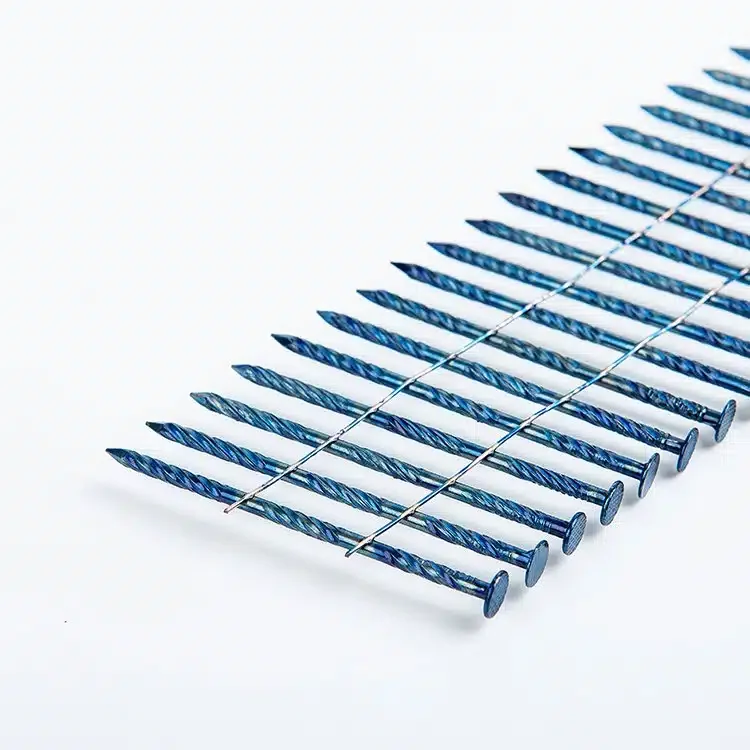
Smooth shanks have a plain body, ring shanks have circumferential features, and screw or spiral shanks have a helical pattern. These descriptions identify geometry. They do not establish a load rating, coating system or approved use. A spiral driven nail should also remain distinct from a wood screw installed by rotation.
When comparing samples, hold the other variables constant where practical: diameter, length, penetration, head and point. A thicker ring nail and a thinner smooth nail are not a controlled comparison of shank alone. Ask the supplier to show the patterned portion on a drawing, including whether the rings or spiral cover the full shank.
Use the size table as a shortlist
The Elite product reference lists 15-degree welded-wire coil nails with discrete combinations from 2.1 to 3.3 mm in diameter and 32 to 100 mm in length. For example, reference 2565 is 2.5 × 65 mm. That reference identifies dimensions; it does not automatically select ring shank, a coating or compatibility with your nailer.
For a replacement order, provide the current carton label and several clear photographs alongside measurements. Include the head and point, the welding-wire positions and the coil orientation. If the reference drawing differs from an existing sample, record the difference explicitly instead of assuming the two are equivalent.
Separate material, finish and validation
A gold, blue or silver product photograph is insufficient to identify steel grade or corrosion protection. State the required material and finish separately, and describe treated timber, outdoor exposure or other conditions that could affect the specification. Request supporting documents when your customer or project requires them.
Approve samples on the intended timber and equipment against written criteria. These may include feeding, achieved driving position, visible splitting and any specified connection testing. A successful sample check covers the documented setup; changes to timber, tool or nail geometry should trigger a review rather than an automatic assumption of identical results.
Send a supplier a complete starting point
For a useful quotation, identify what is already fixed and what still needs a recommendation. This allows a supplier to discuss a feasible specification without treating an incomplete product name as a production instruction.
- Current nail reference or drawing, diameter and length with units.
- Requested smooth, ring or spiral shank; identify full or partial pattern if relevant.
- Timber, board thickness, joint drawing and required acceptance criteria.
- Material, finish, complete nailer or line model, quantity and packaging.
- Destination, sample requirement and any customer-specified documentation.
Put this guide into context
Technical references
References explain selection principles. Confirm the specification for the particular product and assembly you are buying.
Turn the details into an enquiry.
Send your current fastener, application and tool model. We can start with what you already know.