
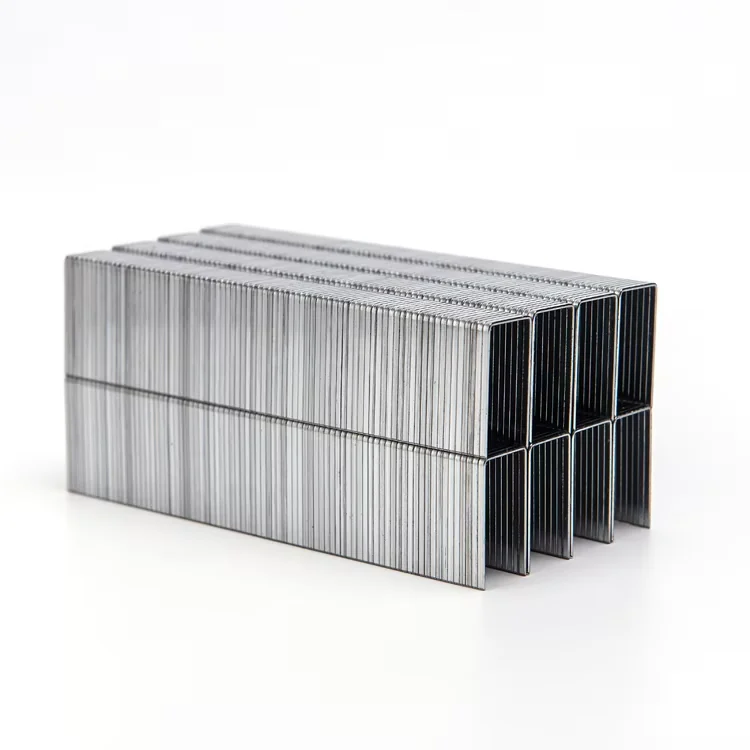
FOR THE BUYER
Request a side-by-side drawing for the current and proposed staple, and approve every dimensional difference with the exact tool and joint before accepting a 90-to-92 substitution.
9040 440K and 9240 catalog comparison for a substitution request
Reference field
9040 440K / 90 family
9240 / 92 family
What to check
Crown, as recorded in the catalog
6.00 mm
8.82 mm
Different crowns require a review of the exact stapler and proposed connection.
Gauge designation
18 gauge
18 gauge
The shared gauge does not establish an interchangeable feed profile.
Formed wire width × thickness
1.26 × 1.00 mm
1.26 × 1.00 mm
Keep the complete cross-section and agreed tolerances with the drawing.
Listed leg lengths
16, 19, 25, 32, 38 mm
15, 20, 25, 30, 35, 40 mm
Compare the actual requested length, not just the endpoints of a range.
25 mm catalog reference
9025
9225
Equal length still leaves different crowns to confirm.
Longest listed reference
9038 / 38 mm
9240 / 40 mm
The 9040 series heading does not create a listed 40 mm variant.
Catalog pieces per row
100
100
Confirm the actual quoted strip, box and carton format.
These are discrete catalog entries, not a continuous size range or a cross-brand equivalence chart. Availability, dimensional tolerances and tool compatibility require confirmation for the proposed variant.
Treat a substitution as a specification change
When a familiar staple is unavailable, a buyer may ask for another 18-gauge series with a similar length. A useful substitution request starts with the original drawing, the equipment and the assembly. Sharing a gauge label does not establish that the replacement fits the magazine, reaches the required position or performs as required in the joint.
SENCO’s published tool documentation illustrates the point by identifying staple style and crown alongside gauge. Its SLS15Mg / SLS18Mg manual, for example, specifies an L-style 18-gauge staple with a quarter-inch crown. That statement applies to those original tools; it is not an equivalence declaration for the catalog families discussed here.
Read the actual 90 and 92 reference dimensions
The supplied 9040 440K Series reference uses a 6.0 mm crown, 1.26 mm wire width and 1.00 mm thickness, with an 18-gauge label and 100 pieces per row. The listed variants are 9016, 9019, 9025, 9032 and 9038, corresponding to 16, 19, 25, 32 and 38 mm legs.
The 9240 Series has an 8.82 mm crown with the same reference wire width, thickness, gauge and row count. Its listed lengths are 15, 20, 25, 30, 35 and 40 mm. The different crown and length schedule mean the two tables cannot be merged into one interchangeable size range.
Do not create a size from the series heading
The 9040 440K heading may suggest a 40 mm product, but the supplied table ends at 9038 / 38 mm. A request for 40 mm should therefore ask whether such a variant is available and require its drawing. It should not silently reuse the 9038 reference.
This discipline is useful for other staple families too. A series name, a supplier shorthand and a leg-length code may follow different naming conventions. Retain the complete reference shown on the sample and label. If the proposed supplier uses a new code, ask for a written mapping to the agreed dimensions.
Review the joint before accepting a different crown
Tell the supplier what is being fastened: cabinet parts, paneling, a timber frame or another assembly. Provide material thicknesses and explain any visible-face or penetration restrictions. The catalog lists several wood-assembly applications, but those descriptions are starting points rather than approval for a specific connection.
Where a project requires a particular fastener or test result, ask the responsible specifier to review a substitution. For production evaluation, record the candidate reference, tool model, workpiece and acceptance criteria. Keep feeding observations separate from joint performance: correct feeding alone does not establish that the completed connection meets the purchaser’s requirements.
Send enough information to compare alternatives
Request a side-by-side dimensional comparison instead of asking only whether a product is equivalent. Ask the supplier to identify every difference and confirm the actual supply and packaging proposed.
- Current series and code, required leg length and crown convention.
- Wire width, thickness, material, finish and point requirements.
- Full stapler model, current carton label and any relevant manual extract.
- Assembly drawing, substrate, visible-surface restrictions and approval criteria.
- Quantity, row and carton packing, destination and sample approval requirement.
Put this guide into context
Technical references
References explain selection principles. Confirm the specification for the particular product and assembly you are buying.
Turn the details into an enquiry.
Send your current fastener, application and tool model. We can start with what you already know.